


What's Happening at Month 5
Five months is when most babies really start to make big strides in development. There's a major increase in manual dexterity, a spike in curiosity and thought complexity, and much more interactive behaviour — this is when you'll start to clearly see the little gears turning.
Your five-month-old's fine motor skills have come a long way. They're probably reaching for their toys and able to hold them without difficulty — even manipulating them with deliberate purpose, examining and exploring them in multiple ways. They've also figured out that they can make things happen: your baby might cry very deliberately to see if you'll come check on them.
Communication has taken a big step forward. Your baby is making real sounds now — not just crying, but cooing and gurgling in deliberate experiments. They listen closely when you speak, watching your mouth's movements, then experiment with their own vocal abilities, mimicking you.
What's Developing Right Now
The highlights across all three development pillars at Month 5.

Physical
Fine motor leap — grasps, holds, and deliberately manipulates objects · Reaching is now reliable and intentional

Cognitive
Insatiable curiosity — holds, turns, shakes, and mouths everything · May recognize own name when called · Beginning to understand they can make things happen

Social & Emotional
Mimicking your sing-song tone when babbling · Blowing raspberries · Smiling at themselves in mirrors · Recognizes and smiles at other babies
Month 5 Development Areas
Sensory Development
Sensory Development
Sensory development from the earliest months continues to build at this stage. Your baby is becoming increasingly responsive to familiar sounds, faces, textures, and environments. Every consistent sensory experience is deepening their neural map of the world around them.
Gross Motor Skills
Gross Motor Skills
Gross motor development builds progressively through the first year. The strength and coordination your baby is developing right now through tummy time, reflexive movement, and daily activity is laying the foundation for crawling, standing, and walking ahead.
Fine Motor Skills
Fine Motor Skills
Your five-month-old's fine motor skills have come a long way. They're probably reaching for toys and able to hold them without difficulty — even manipulating them with deliberate purpose.
What you can do: Offer toys that require grasping and holding: rings, rattles, soft blocks. Place toys just within reach so they practice extending and grasping
Balance & Coordination
Balance & Coordination
Balance and coordination milestones begin to emerge from Month 6 with sitting. The foundations are being built through tummy time and reflexive movement right now.
Curiosity & Discovery
Curiosity & Discovery
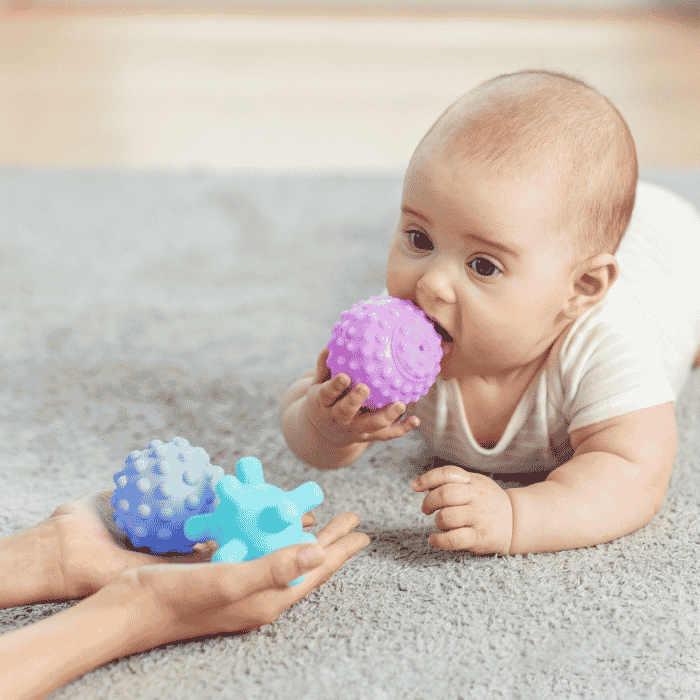
Your little five-month-old is more curious than ever. Now that they can grasp and manipulate, they want to play with and explore everything — holding, turning, shaking, feeling, and inevitably putting in their mouth. They may also have learned their own name and will look up when they hear it.
What you can do: Name everything. Use your baby's name consistently. Offer a variety of objects to explore — not just toys, but safe household items of different textures.
Imagination & Creativity
Imagination & Creativity
Imaginative and creative development begins to emerge around 12–18 months. Right now, your baby is building the sensory and cognitive foundations that will support creativity later.
Thinking & Problem Solving
Thinking & Problem Solving
At five months, your little one's brain has become more complex. They understand that their actions have direct effects on the world and will start experimenting — deliberately making noise to see if you respond, for example. They may also be able to do two things at once: playing with a toy and babbling to you about it simultaneously.
What you can do: Respond to their experiments. When they cry deliberately, go to them and acknowledge it. When they babble while playing, join in the conversation.
Academics
Academics
Early academic foundations — language, numeracy, and literacy awareness — begin to develop from Month 9. For now, every word you speak and every face you show is building the cognitive architecture for future learning.
Sharing & Cooperation
Sharing & Cooperation
Social sharing and cooperation emerge from Month 6. Right now, the most important social development is the bond forming between your baby and their primary caregivers.
Listening & Communication
Listening & Communication
At five months, your little one is getting to be quite the communicator. They listen closely when you speak, watching your mouth's movements, then experiment with their own vocal abilities, mimicking you. They'll try different sounds, and may even take a stab at the sing-song inflection you use when speaking to them.
What you can do: Exaggerate your expressions and vocal variety. Baby is studying your face like a musician studies sheet music — every change is information.
Self-Expression & Confidence
Self-Expression & Confidence
Your little one is interested in people around them and when happy, not afraid to show it. They've started recognizing and smiling at other babies — including themselves in the mirror! They also love playing with new expressive abilities like blowing raspberries.
What you can do: Use a baby-safe mirror during play. Blow raspberries back. Delight in every expression — your matching response reinforces that emotion is worth expressing.
Security & Happiness
Security & Happiness
Security and happiness are built through consistent, responsive caregiving in the early months. Every time you respond to your baby's cues, you are building the secure attachment that underpins all future emotional development and wellbeing.
Recommended Toys & Books for Month 5

Fat Brain Toys PlayTab Essentials


Bright Box 1: Infant Exploration & Sensory Discovery


3-in-1 Stacking Cups: Bird's Nest *

Bright Starts Rollin' Rainstick Rattle


How to Play with Your 5-Month-Old
- Safe mouthing — Offer a variety of safe, cleanable teething toys in different shapes and textures. This IS developmental learning — don't redirect it, support it.
- Supported sitting play — Sit baby between your legs on a soft mat, with toys at arm's reach. This builds core strength for the sitting milestone ahead.
- Peek-a-boo beginning — Hide your face behind your hands, then reveal with delight. Object permanence is starting to emerge.
- Two-handed play — Offer toys large enough to hold with both hands, or two small toys simultaneously. Bilateral coordination is building.
The milestones on this page are intended for educational reference only. Every child develops at their own pace — earlier or later than described here is often completely typical. If you have concerns about your child's development, please speak with your paediatrician. Bright Bean Toys does not provide medical advice.

