


What's Happening at Month 9
At nine months, babies have spent nearly as much time developing outside the womb as they did inside. This is a month of significant new developments and refinement of previously learned behaviour.
One of the most important new developments is size perception. Your baby now understands that size matters and adjusts their approach accordingly — if reaching for something tiny, they'll do it with fingers in a pincer-like position. If after something larger, they'll use both hands.
Word associations are forming. Your nine-month-old's list of words they understand is growing, and they may grasp the abstract relationship between an object's name and its function — they might get excited when they hear you say the word "toy," or look for the cat when they hear "meow."
What's Developing Right Now
The highlights across all three development pillars at Month 9.

Physical
Pincer grasp emerging — index finger and thumb working together · Size perception — adjusts grip based on object size · Pulling to stand on furniture beginning

Cognitive
Objects have purposes — buttons are for pushing · Beginning to use one toy as a tool to manipulate another · Word associations forming (meow = cat)

Social & Emotional
Complex intentional gestures — waving, lifting arms to be held · Babbling sounds like a real language · Responds reliably to own name
Month 9 Development Areas
Sensory Development
Sensory Development
Your little one can now perceive that size matters. They know when an object is big or small and may adjust their actions accordingly — pincer grip for tiny objects, both hands for larger ones.
What you can do: Offer objects of varying sizes. Notice how they adjust their approach. This is early spatial and tactile reasoning.
Gross Motor Skills
Gross Motor Skills
As your little one crawls along, they'll soon be using furniture and maybe even your legs and feet to support corrections in posture and balance. These experiments with using stable objects to support themselves will eventually lead to standing up.
What you can do: Ensure furniture is stable. Let baby pull up on your hands and legs. Hold them steady but let them do the work.
Fine Motor Skills
Fine Motor Skills
You can finally try a game of ball with your baby! They can probably sit on the floor and catch a slow-moving ball rolled right to them. Don't expect them to send it back your way yet.
What you can do: Roll a soft ball slowly toward baby. Cheer when they catch it. This is the beginning of ball play — a social and fine motor milestone.
Balance & Coordination
Balance & Coordination
Balance and coordination milestones begin to emerge from Month 6 with sitting. The foundations are being built through tummy time and reflexive movement right now.
Curiosity & Discovery
Curiosity & Discovery
Your nine-month-old is beginning to understand what certain objects are for. During exploratory play, they'll begin to assign purposes that make sense — a block is for banging on the floor, a button is for pushing, a toy phone is for putting to your ear.
What you can do: Use objects for their intended purpose in baby's view — talk on a toy phone, stir with a spoon. They're watching and cataloguing.
Imagination & Creativity
Imagination & Creativity
Imaginative and creative development begins to emerge around 12–18 months. Right now, your baby is building the sensory and cognitive foundations that will support creativity later.
Thinking & Problem Solving
Thinking & Problem Solving
Your little one may be starting to solve problems more creatively — they'll recognize the potential of objects as tools. For example, they might use one toy to manipulate another that's out of reach.
What you can do: Set up simple "tool problems" — a toy slightly out of reach, another toy they could use to drag it closer. Let them figure it out.
Academics
Academics
Your nine-month-old's list of words they understand is growing. They may grasp the abstract relationship between an object's name and its function — getting excited when they hear "toy," looking at daddy when asked where daddy is, associating "meow" with cat.
What you can do: Name everything consistently. Build sound-object associations: meow when you see a cat in a book, woof for dog, vroom for car. Repetition builds these associations into lasting pathways
Sharing & Cooperation
Sharing & Cooperation
Social sharing and cooperation emerge from Month 6. Right now, the most important social development is the bond forming between your baby and their primary caregivers.
Listening & Communication
Listening & Communication
When your little one wants something, they likely know how to tell you. They may wave goodbye when it's time to go, or lift their arms toward you when they want to be held. Their babbling has started to sound more complex and diverse, like the sounds of a real language — stringing lots of different syllables together just like you do when you speak.
What you can do: Honour every gesture with a consistent response. When they lift their arms, say "You want up!" and pick them up. This maps words to experiences.
Self-Expression & Confidence
Self-Expression & Confidence
Self-expression begins to emerge from Month 4 onward. For now your baby's expressions are largely reflexive — but you may already notice patterns beginning to hint at their unique emerging personality.
Security & Happiness
Security & Happiness
Security and happiness are built through consistent, responsive caregiving in the early months. Every time you respond to your baby's cues, you are building the secure attachment that underpins all future emotional development and wellbeing.
Recommended Toys & Books for Month 9

Plan Toys Baby Car - Modern Rustic


Baby Einstein Curiosity Kaleidoscope Electronic Toy

Recycled Agains Friends - Cow 12"


Bright Box 1: Infant Exploration & Sensory Discovery


Fat Brain Toys PlayTab Essentials

B. Toys Boogie Bus Rrrroll Models


Ingenuity Sylvi Natural Rubber Teether

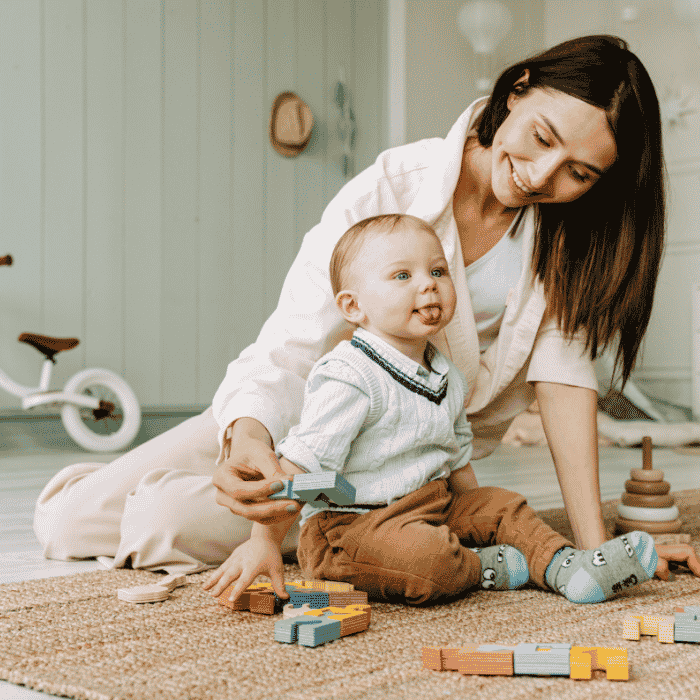
How to Play with Your 9-Month-Old
- Pincer practice at mealtimes — Safe food puffs or small pieces of soft food are perfect pincer practice that doesn't feel like practice.
- Pointing and naming — Point to things and name them. Wait for baby to point back. When they do, name what they're pointing at. This is joint attention — a critical language milestone.
- Nesting cups — Stack, nest, fill, empty. Stacking cups require exactly the precision, spatial reasoning, and cause-effect understanding all emerging right now.
- Waving practice — Wave hello and goodbye consistently, every time. Repetition builds the gesture into reliable, intentional communication.
The milestones on this page are intended for educational reference only. Every child develops at their own pace — earlier or later than described here is often completely typical. If you have concerns about your child's development, please speak with your paediatrician. Bright Bean Toys does not provide medical advice.

